
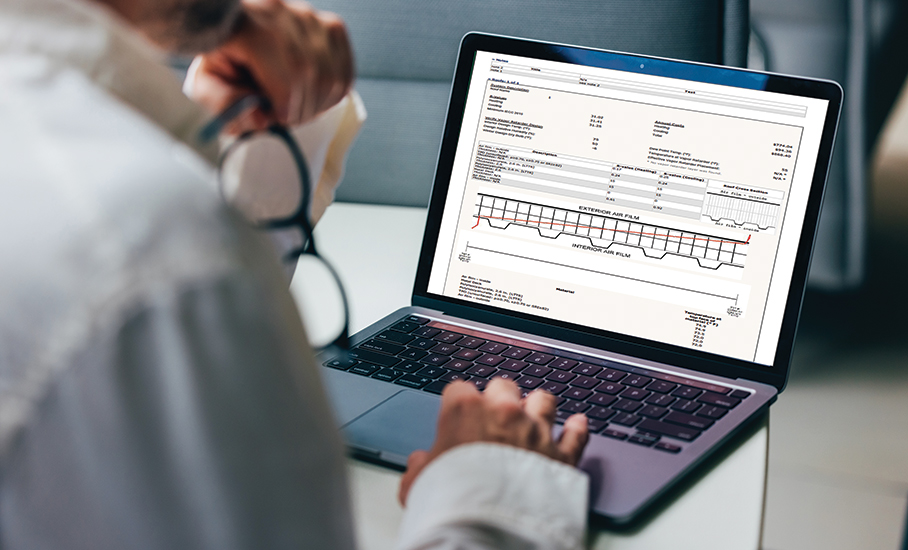
NRCA has updated its EnergyWise Roof Calculator, a free online calculator that determines roof assemblies’ minimum thermal insulation requirements and energy usage costs for heating and cooling for specific low-slope roof assembly designs. The update incorporates the latest revisions to model energy codes and energy-efficiency standards.
To date, nearly 6,300 registered users have input more than 13,000 projects. With this new update, these numbers should increase significantly.
How it works
EnergyWise enables users to input a building’s size and location, select a standard or code, and complete specific climate and building information for a project. Heating and cooling information, such as the type of heating appliance, interior design temperature and relative humidity, are collected to determine annual energy costs and dew point for vapor retarder placement.
Details about the roof are added layer by layer. Users can select materials like rigid board insulation and membrane, each with a specific set of properties that affect a building’s energy efficiency. R-values are provided for common material types and thicknesses.
NRCA recommends designers use a design R-value of 5.0 per inch thickness for polyisocyanurate insulation in all climates for more accurate performance evaluations. There also is the option to use the LTTR value of 5.6 per inch or manually enter another value. Keep in mind NRCA does not consider LTTR use to be appropriate for roof system design purposes when actual in-service R-values can be important aspects of roof system and whole building performance.
Results generated by EnergyWise can be viewed from within the online application, and users can generate detailed reports of the specific buildings and roof areas analyzed. Results also are saved in a user’s personal account for future reference.
Results generated by EnergyWise can be viewed from within the online application, and users can generate detailed reports of the specific buildings and rood areas analyzed.
What’s new
With this recent update, EnergyWise now includes minimum R-value requirements for roof assemblies from the following codes and standards:
- International Energy Conservation Code®: 2000, 2003, 2006, 2009, 2012, 2015, 2018, 2021 and 2024 editions
- ASHRAE 90.1: 2004, 2007, 2010, 2013, 2016, 2019 and 2022 editions
- International Green Construction Code®: 2012 and 2015 editions
- ASHRAE Standard 189.1, “Standard for the Design of High-Performance Green Buildings”: 2009 and 2011 editions
In addition, the following updates to the program allow for new and improved energy estimates:
- 2024 IECC and 2022 ASHRAE 90.1 climate zones
- Heating degree days and cooling degree days for all climate regions
- Design heating dry bulb temperature
- Fuel cost estimates
Requirements and calculated estimates provided in the report are based on information found in the referenced codes and standards. R-value requirements for a project are determined based on the climate zone of the county in which a building resides; climate zones are based on heating degree days and cooling degree days.
Heating degree days and cooling degree days measure the difference between outside temperatures and design inside temperatures on a daily basis throughout the year. The higher the numbers, the more HVAC equipment has to work to condition an inside space.
As new weather stations are built, more data is collected and heating and cooling requirements change over time, climate zones are updated.
ASHRAE and IECC had unique changes to their climate zone lists in their latest versions. For example, heating degree days, cooling degree days and design heating dry bulb temperatures for more than 2,700 stations in the U.S. were added or updated so the estimated energy costs and dew point locations for vapor retarder placement can be more accurately determined.
Default fuel costs have also been updated to reflect the latest information available from the U.S. Energy Information Administration, which is part of the Department of Energy.
Estimates only
EnergyWise results are estimates based on recognized engineering principles using the parameters input by users. Actual energy costs and savings are based on multiple factors, including specific energy costs during an analysis period, actual building operation, and interior and exterior temperature conditions during the analysis period.
To download NRCA’s Industry Issue Update regarding polyisocyanurate R-values, go here.
Also, EnergyWise only evaluates a building’s roof assembly and does not consider other building envelope components, such as walls, windows and doors, which can be large overall contributors to heating and cooling losses and overall building energy costs. For these reasons, NRCA recommends EnergyWise’s results only be used for comparison purposes. Specific representation or guarantees of actual energy cost savings should not be made.

KURT FESTER, BECxP, CxA+BE
A director of technical services
NRCA