
Two roofs installed on the same day can age quite differently. That is obvious to anyone who has spent time in the field. What’s more difficult to measure is how much and how local climate conditions help explain the difference.
A roof’s age tells us how long it has been there. Its condition tells us what it has been through.
Most of the attention paid to weather and roofs understandably goes to an event: a hurricane, hailstorm or severe rainfall that produces visible damage. Another part of the story happens in the days in between. Heat, humidity, daily temperature fluctuations and intense rainfall place repeated demands on roof systems over years—even without a single catastrophic event to point to.
To better understand how those conditions correspond with roof age, my company, Nearmap, an aerial technology and property intelligence company, analyzed billions of AI-derived roof observations across the U.S. The analysis looked for relationships between climate conditions, average observed roof age and replacement frequency.
The results showed substantial differences in the age and replacement frequency of roofing stock across the U.S.
About the study
More than 2.8 billion AI-derived roof observations from nearly 2,100 U.S. counties were studied. County-level roof-age data was paired with five-year average climate conditions from gridMET, a climate dataset developed by the Climatology Lab at the University of California, Merced. The analysis focused on relationships between climate conditions, average observed roof age and replacement frequency. The findings represent population-level patterns not a formula for predicting the service life of an individual roof.
Key findings
Following are key findings of the study at a glance.
- Three climate factors had the strongest relationship with younger average roof age: daily temperature swings, heat combined with humidity and extreme rainfall.
- The average observed roof age varies by more than seven years across the U.S. (see Figure 1): Average roof age ranged from 16.2 years in Nevada to 8.9 years in Louisiana. States with the youngest average roofs showed replacement frequency more than 80% higher than states with the oldest averages.
- Large daily temperature swings corresponded with younger roofs: Counties where mean daily temperature fluctuations exceeded 23 degrees F had an average observed roof age of 9 years compared with 11.1 years where fluctuations remained below 20 degrees F, a difference of about 23%.
- Heat and humidity together were associated with the youngest average roofs: Hot, high-humidity counties had an average observed roof age of 8.5 years compared with 11 years in cool, low-humidity counties.
- The geographic footprint of intense rainfall has grown considerably: In counties experiencing the highest rainfall intensity, the youngest average roofs were observed.
For contractors, the practical takeaway isn’t climate history replaces an inspection. It doesn’t. It gives more context before, during and after the inspection: where to look more closely; what may help explain deterioration that seems early for a roof’s age; and how to have more specific conversations about maintenance, repair and replacement.
The seven-year spread in average roof age also needs context. Climate is one part of the explanation. Construction standards, material choices, maintenance, installation practices, development and severe weather can all contribute to when roofs are replaced. When roof-age patterns are compared with long-term climate conditions across nearly 2,100 counties, several relationships stand out.
A roof installed 10 or 15 years ago may face heat, humidity or rainfall patterns today that were less common in that market when it was installed
Thermal cycling
Here’s what we found when we looked at the climate factors individually.
Of the climate variables studied, daily temperature fluctuation had one of the strongest relationships with average observed roof age.
Roofing materials expand as they heat during the day and contract as temperatures drop. That movement happens repeatedly during the life of a roof, placing stress on components such as fasteners, sealants, flashing and, depending on the roof system, the material itself.
What to watch for: In markets with large daily temperature swings, repeated movement can make fasteners, sealants, flashing, vents, penetrations and other transition points worth closer attention depending on the roof system being inspected.
Counties where mean daily temperature fluctuations exceeded 23 degrees F had an average observed roof age of 9 years. Counties where those fluctuations remained below 20 degrees F averaged 11.1 years, a difference of 2.1 years or about 23%.
A few degrees of additional variation on any given day may not sound like much, but a roof doesn’t experience that difference once. It experiences it thousands of times. Unlike hail, wind or heavy rain, thermal stress doesn’t necessarily leave behind a single event that explains the wear. It builds through repeated expansion and contraction across seasons and years.
That history can also shape the condition of a roof when severe weather eventually arrives. Two roofs may have the same installation date, but years of different thermal exposure can leave them entering the same storm in quite different conditions.
The specific effects will vary by roof system. Asphalt shingles, tile, metal, single-ply membranes and low-slope assemblies don’t respond identically to environmental exposure. Material, installation, maintenance and property-specific conditions all factor into performance.
Temperature history alone can’t determine the remaining service life of a roof. But for a roof performing differently than its age would suggest, thermal exposure may help explain what’s happening.
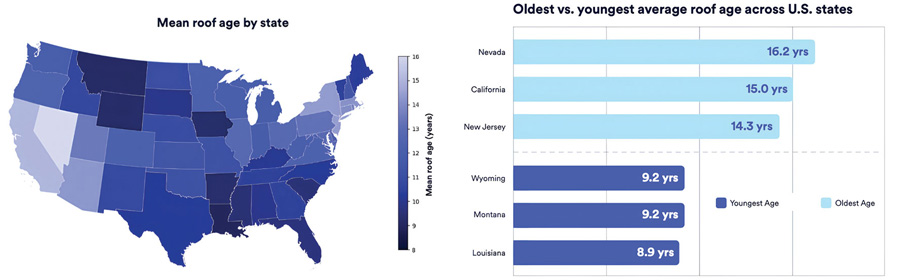
Source: Nearmap’s 2026 study, “What America’s Roofs Reveal About Climate Risk”
Heat and humidity
Heat and humidity each showed a relationship with average observed roof age; together, they were associated with the youngest average roof age of any climate pairing in the analysis.
Hot, high-humidity counties had an average observed roof age of 8.5 years compared with 11 years in cool, low-humidity counties. Heat and humidity can contribute to biological growth, moisture issues and material breakdown, which may help explain part of the observed difference.
Some county-level differences were even larger. Taylor County, Fla., averaged 5 years; Walthall County, Miss., averaged 5.2 years; and Madison County, Fla., averaged 5.6 years. Roofs in those counties were being replaced about twice as frequently as those in cooler, drier parts of the U.S.
These regional averages are not expected service lives for individual roofs. A younger average roof age can have several explanations, including new construction and development. Across a large population of properties, it can also correspond with more frequent replacement.
The combined heat-and-humidity finding also shows why temperature alone doesn’t tell the full story. Two markets can share similar temperatures while exposing their roofing stock to different conditions. A system performing under hot, dry conditions has a different exposure history from one experiencing similar heat alongside persistent humidity.
Heavy rainfall
Rainfall presents a different issue because the exposure itself is shifting. Heavy rainfall can stress drainage systems, exploit weaknesses in flashing and seals, and contribute to water intrusion. Counties experiencing the highest rainfall intensity also tend to have the youngest average observed roofs.
From 1980-84, about 35,000 square miles of U.S. land fell within the highest precipitation band studied. By 2024, that footprint exceeded 300,000 square miles, an increase of about 750%.
What to watch for: In hot, humid markets, signs of moisture intrusion, biological growth and material deterioration may warrant additional attention. The specific failure modes will vary by system and assembly.
The side-by-side maps in Figure 2 show how much that footprint has expanded. Areas that historically experienced more moderate rainfall now may be encountering conditions that were less common when some current roof systems were installed. The roofs have not moved, but the conditions around them have.
For a roof system expected to remain in service for decades, conditions at installation may not represent everything it encounters during its lifetime. Materials selected now are expected to perform years down the road. Maintenance practices develop from experience about how systems behave locally. Replacement expectations are informed, in part, by what contractors have seen across earlier generations of roofs in a given market.
The rainfall finding shows the geographic boundaries of exposure can change during the service life of the roof itself. Contractors can work in the same market for decades while the roofs around them encounter different rainfall patterns.
Combination of conditions
What to watch for: Where intense rainfall is common or has increased, drainage capacity, ponding, flashing, seals, penetrations and existing points of water intrusion may deserve closer attention. Long-term climate data can also add context to changes contractors observe across successive inspections and generations of roofs.
The study isolates climate variables so we can see how each relates to roof age. In practice, of course, no roof experiences them one at a time. Thermal cycling, heat, humidity and intense rainfall can overlap across a roof’s service life, layered on top of differences in materials, installation quality, ventilation, drainage and maintenance.
Therefore, the findings shouldn’t be read as a formula for predicting the life span of an individual roof. A certain temperature swing doesn’t subtract a fixed number of years, and living in a hot, humid county doesn’t dictate when a roof will need to be replaced. What the scale of the data can show is whether certain conditions consistently correspond with different roof-age and replacement patterns across large populations of properties.
Patterns that are difficult to spot from a single roof, neighborhood or season become clearer when billions of observations are considered across thousands of counties. An inspection can tell you a great deal about the condition of one property. Regional data can show whether that property’s experience resembles what’s happening across thousands of others exposed to similar conditions.
Field expertise provides the property-specific judgment while large-scale data adds context that can be challenging to see one roof at a time. Put them together, and you get a more complete picture: what’s happening on the roof and whether that condition is typical for properties facing similar exposure.
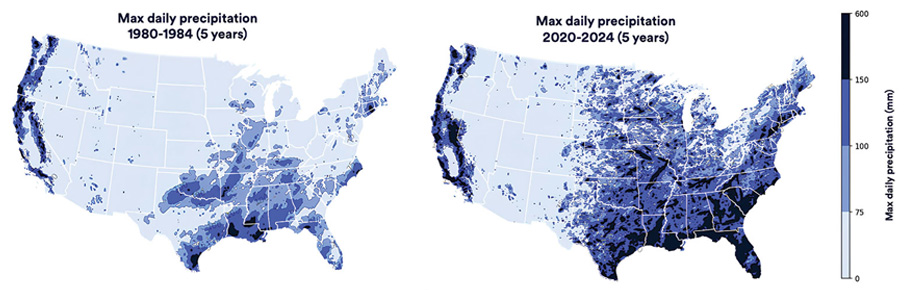
Source: Nearmap’s 2026 study, “What America’s Roofs Reveal About Climate Risk”
Service-life conversations
The climate-specific takeaways can help guide what roofing contractors look for on a roof. The research also has broader applications for how roof age is discussed with customers and how performance is considered from one market to another.
“How much longer will my roof last?” sounds like a simple question. Anyone who has inspected enough roofs knows the answer depends on more than the installation date. Customers naturally want a number. A roof installed in a certain year and the material installed carries an expected service life and the temptation is to subtract one from the other. Real life makes the math less tidy.
The findings give contractors another way to explain why two roofs of the same age can be in different conditions.
A roof that has spent years cycling through large temperature swings has one exposure history. A roof that has experienced persistent heat and humidity has another. A roof system in a market where intense rainfall has become more common may encounter different conditions during the second half of its service life than it did during the first.
That context can make conversations about maintenance, repair and replacement more specific to the roof in front of the customer. Expected service life works better as a benchmark than an expiration date. The installation date establishes where the clock started; observed condition and exposure history help explain what happened after that.
For property owners, this can turn a conversation about “How old is my roof?” into a more useful discussion about “How is my roof actually performing?”
Local service life
Roofing is local in ways that don’t always show up on a product spec sheet. Materials and installation practices vary by region. So do building codes and the mix of heat, humidity, temperature swings and rainfall a roof system encounters during its lifetime.
A contractor expanding into a new service area may know a roof system extremely well while having less history with how that system performs under the new market’s conditions. The state and county differences in the study show how much average observed roof age and replacement behavior can vary geographically.
A low average roof age also needs to be interpreted in context. It may reflect recent construction or development; across a larger population, it can also signal more frequent replacement. Knowing the market helps distinguish between those explanations.
Replacement introduces another local variable: sourcing. Material availability and pricing differ by market, so comparable roofing materials may not be equally available or cost the same from one location to another. An estimate is most useful when it reflects what the material can actually be sourced for in the market where the work will take place.
For companies working across multiple regions, these differences add up. The same roof system can encounter different environmental conditions, replacement patterns and sourcing realities from one market to another.
Someone who has spent years inspecting roofs in a region develops an understanding of what tends to fail, when it fails and how materials respond to local conditions. Large-scale data can show how those observations compare with patterns across a broader region.
The full picture
Climate risk doesn’t only arrive with hurricanes, hailstorms or wildfires. Roofs are exposed to their environments every day, and those exposures accumulate over time.
To read the full report visit What America's Roofs Reveal About Climate Risk.
For roofing contractors, the opportunity is to connect what they see in the field with what a roof has experienced over time. Property intelligence can provide a record of age, condition and change; regional weather patterns add the environmental history. Together, they provide a fuller picture of why otherwise similar roof systems can age quite differently.
The environment doesn’t stand still. A roof installed 10 or 15 years ago may face heat, humidity or rainfall patterns today that were less common in that market when it was installed.
A roof installed for yesterday’s conditions may spend much of its service life facing tomorrow’s conditions. Understanding that shift can help inform how roofs are inspected, maintained, repaired and replaced.

DAVID TOBIAS
Chief product officer
Nearmap, Levi, Utah